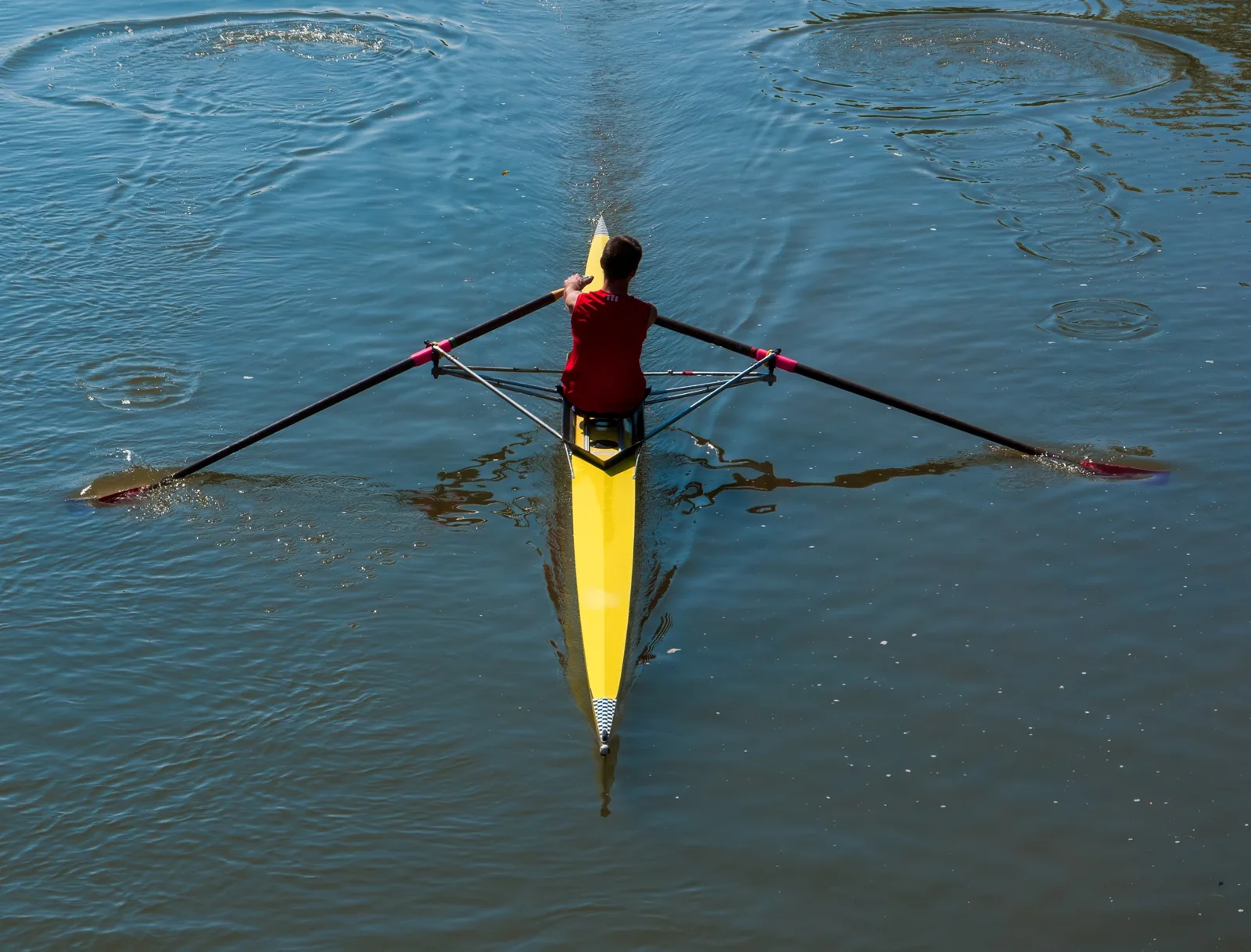
Companies often talk about team spirit. They describe it in their values, meetings and projects. Yet what makes a group work is not always easy to see when everyone stays in their usual role. Rowing offers a shift in perspective: people leave familiar settings to share a situation in which their contributions are interconnected. The boat becomes a space for experience, not scientific proof or a business diagnosis. The idea championed by Esprit d’Équipe Rowing is simple: a high-performing boat is never just the sum of good rowers. It is a group capable of working together. This distinction gives an experience built around the group its full strength.
Why is individual contribution not enough?
In rowing, effort alone does not define the group’s success. Movement must take account of the boat and the other rowers. This interdependence makes a question found in business tangible: how can individual contributions become part of a shared endeavour?
This is not about setting the individual against the group. Each person matters precisely because their action takes place in relation to others. Coordination does not erase differences; it calls for listening to them and making adjustments. A team can therefore experience, rather than simply hear, the idea that shared success depends on how its members cooperate. This observation opens up a useful discussion without allowing definitive conclusions about participants’ professional abilities.
What does listening mean in a crew?
Listening is not simply waiting for someone to speak. In a rowing experience, listening translates into attention to instructions, signals and the group’s rhythm. Everyone must accept that their own movement forms part of a shared sequence. This attentiveness can be more meaningful than an abstract speech about cooperation.
Participants may notice habits: wanting to go too fast, not asking when an instruction is unclear, or spontaneously adjusting to others. These observations must not become labels. The situation is new, and reactions may be influenced by many factors. The debrief is there to explore what happened with curiosity. The question is not ‘who failed?’, but ‘what helped us move forward together?’.
How does coordination create a shared experience?
Finding a shared rhythm requires attention and adjustment. When the team feels better coordinated, it can recognise the difference between acting side by side and acting together. This feeling gives team spirit a tangible dimension: people no longer merely share a space; they take part in a shared movement.
How each person experiences this moment remains personal. It would not be honest to promise every employee the same emotion. Esprit d’Équipe Rowing’s ambition is to offer an enjoyable, challenging and human experience in which the group can experience something different. A shared memory is not a statistic to announce. It is a design intention: making room for what participants feel and what they will later be able to recount.
Why do trust and mutual support have a particular role?
Within a group, a difficulty can lead someone to withdraw or ask for help. Rowing brings this relationship with others to the fore because the group must take everyone into account. Trust can be expressed through accepting an instruction, being able to voice a hesitation or paying attention to another participant’s rhythm.
Mutual support is not limited to encouraging those who feel most comfortable. It can involve clarifying what has not been understood, adjusting expectations or recognising a quiet contribution. These dimensions are part of the positioning supplied by the client. Their practical arrangements will depend on the format developed and must be confirmed. The quality of the project also rests on a framework that does not confuse pushing personal boundaries, competition between colleagues and pressure to participate.
What can be transferred to work without oversimplifying?
The boat offers a powerful image, but it should not become a universal explanation of business. At work, objectives may be multiple, constraints different and roles more complex. A rowing experience does not resolve these particularities. However, it can provide a shared vocabulary for discussing listening, adjustment and coordination.
After the experience, invite the team to identify a workplace situation that reminds them of what they experienced. What information is missing for finding a shared rhythm? Where does each person need to understand others better? What makes asking for help possible? These questions remain open and belong to the group. Rowing’s value as a revealing experience lies in its ability to make a discussion more concrete, not to rank people or produce an automatic diagnosis.
What are the key takeaways?
Is rowing purely about strength?
Esprit d’Équipe Rowing’s approach emphasises listening, communication and group coordination, not just individual effort.
Can we discover this approach without a sporting background?
The discovery day is designed as an accessible first experience, even without any sporting background. Practical conditions are agreed during discussions.
Which format should you explore for your team?
Discover the format linked to this reflection, then request a proposal for your company.
Read the frequently asked questions to prepare for your project.